The global e-cigarette industry in 2026 is standing at a clear turning point.
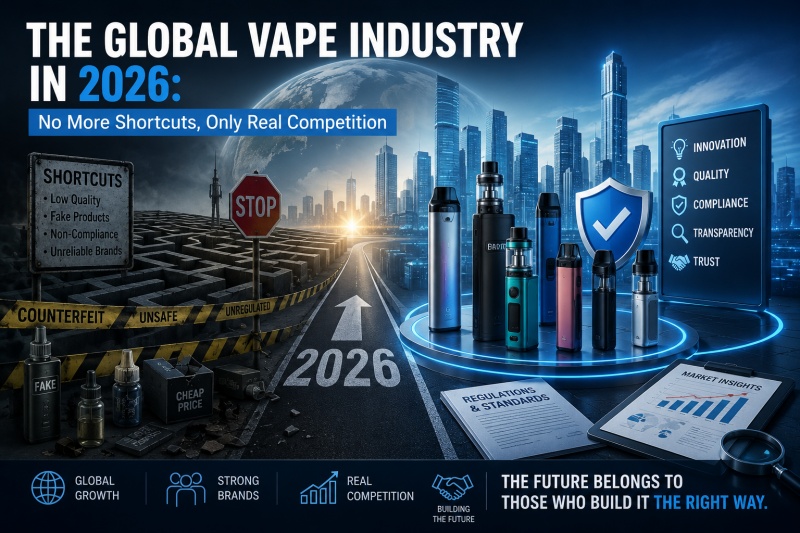
This is no longer a market driven by shipping volume, aggressive pricing, or short-term marketing spikes. The rules have changed. Regulation is tightening across major regions, disposable products are being pushed out of key markets, and next-generation nicotine technologies are reshaping the competitive landscape.
What remains is a more demanding but more stable industry—one where survival depends on compliance, innovation, and long-term system building.
1. A Market That Is Splitting in Three Directions
The first major shift in 2026 is the clear fragmentation of product categories. The industry is no longer moving as one unified market.
Disposable vapes: the end of the expansion era
Disposable e-cigarettes once served as the fastest entry point for global expansion, especially for Chinese exporters. That era is ending.
Across multiple regions, policy pressure is accelerating:
- The UK has already implemented a full ban on * disposable vapes, with enforcement including fines and potential criminal penalties for repeat violations.
- France and Belgium have introduced similar restrictions.
- Germany has begun legislative work to ban disposables due to environmental and fire safety concerns.
- The EU is moving toward stricter battery and product design rules that will effectively block most disposable devices from entering the market after 2027.
At the same time, taxation on e-liquids is increasing across Europe, and nicotine products are being placed under the same regulatory logic as traditional tobacco.
The result is simple: disposable vapes are rapidly losing legal space in developed markets.
HNB: the fastest-growing mainstream category
While disposables decline, heated tobacco products (HNB) continue to expand strongly.
The global HNB market is projected to grow at a double-digit CAGR through the early 2030s, driven by two key forces:
- Strong alignment with regulatory expectations (no combustion, reduced emissions)
- Better long-term environmental profile compared to disposable products
In many markets, HNB is becoming the “acceptable alternative” for regulators and adult consumers alike.
Large tobacco companies continue to dominate this category, with leading brands holding strong positions in Japan, Europe, and emerging Asian markets. However, competition is still evolving, especially around pricing strategy, device differentiation, and distribution control.
Nicotine pouches: the quiet third growth engine
Nicotine pouches are emerging as another fast-expanding category.
Growth is driven by:
- Smoke-free usage format
- Expanding retail acceptance
- Increasing consumer demand for discreet alternatives
Although still smaller than HNB in overall scale, the category is growing rapidly in multiple global markets and is becoming a strategic focus for major tobacco players.
Key takeaway
By 2026, the market is no longer unified. It is splitting into three distinct paths:
- Disposable products → shrinking under regulation
- HNB → expanding and stabilizing
- Nicotine pouches → fast-growing niche with long-term potential
For exporters, this means one thing: product strategy is no longer optional—it is survival-level decision-making.
2. Technology Becomes the Real Entry Barrier
In earlier years, innovation in vaping was mostly about flavor, design, or marketing.
In 2026, technology has become a regulatory requirement.
Two technology tracks now define market access:
A. Compliance technology: age verification and controlled access
One of the most important developments is the integration of advanced age verification systems into vaping devices.
New regulatory approvals in the U.S. have highlighted how critical these systems are for product authorization. Some approved solutions now include:
- Government ID-based age verification
- Device-phone pairing systems that disable use when separated
- Random biometric authentication checks
In parallel, major industry players are adopting facial recognition and AI-based age estimation tools at retail points of sale, achieving very high verification accuracy.
The direction is clear:
Without device-level age control, many flavored products cannot legally enter key markets.
This is no longer a “feature upgrade.” It is a market access requirement.
B. Environmental technology: sustainability becomes mandatory
Environmental pressure is reshaping product design across Europe and beyond.
Key developments include:
- Biodegradable filters made from plant-based materials such as PLA
- Recyclable device structures designed to reduce electronic waste
- Regulatory taxes targeting cigarette filters and plastic components
The scale of the problem is significant. Trillions of cigarette butts are discarded globally each year, contributing to microplastic pollution and environmental damage.
As a result, governments are introducing stricter environmental rules, and brands are being forced to redesign products from the material level up.
In Europe especially, sustainability is no longer a branding advantage—it is a compliance requirement and a market entry condition.
3. The Reality Behind Export Growth
China remains the dominant global exporter of vaping products.
Export data in 2026 still shows moderate growth in value terms. However, the structure beneath that growth is increasingly fragile.
Two problems are becoming more visible:
1. Rising regulatory mismatch
A large portion of exported products no longer fully complies with destination market regulations, especially in the EU.
This creates a gray zone where products may enter markets through indirect or non-standard channels.
2. Expanding illegal market share in Europe
Illicit trade is becoming a major structural issue in Europe’s vaping sector, with a significant share of products:
- Exceeding nicotine limits
- Missing regulatory labeling
- Avoiding tax registration requirements
This creates instability for both regulators and legitimate manufacturers.
As enforcement improves, non-compliant supply chains will face increasing pressure and market contraction.
4. Three Long-Term Trends That Will Define the Industry
Looking beyond 2026, three structural trends are already taking shape.
Trend 1: A hard split between legal and illegal markets
Regulators in the U.S. and EU are actively tightening enforcement. The gap between compliant and non-compliant products will continue to widen.
Companies that invest early in compliance systems will gain long-term market access advantages.
Trend 2: Technology becomes the main competitive moat
By 2030, leading companies will be defined by their ability to integrate:
- Device-level identity and age verification
- Sustainable material systems
- Modular and adaptable hardware platforms
- Full supply chain traceability systems
Technology is no longer a product feature. It is the core business infrastructure.
Trend 3: Unified regulation of all nicotine products
Governments are gradually treating all nicotine products under a single regulatory framework, including:
- Traditional cigarettes
- E-cigarettes
- HNB products
- Nicotine pouches
This includes harmonized taxation, environmental rules, advertising restrictions, and distribution controls.
The industry is moving toward one unified regulatory system rather than separate categories.
Conclusion: The End of Easy Growth
The global vaping industry in 2026 is no longer defined by fast expansion or easy wins.
It is defined by structural discipline.
- Disposable vapes are exiting major regulated markets
- HNB is becoming the most stable growth engine
- Nicotine pouches are expanding as a new category
- Technology is replacing marketing as the core competitive advantage
- Compliance is no longer optional—it is the foundation of market access
For global exporters, especially those from China, the message is clear:
There are no shortcuts left.
The next phase of the industry will not reward speed alone. It will reward companies that can build compliant systems, long-term product platforms, and real technological depth.
Those who adapt early will lead the next cycle. Those who don’t will be filtered out by the new rules of the game.