Table of Contents
- Data Sources and Methodology
- Executive Summary and Strategic Recommendations
- Market Size and Growth Outlook
- Product Structure Breakdown
- Competitive Landscape and Brand Ecosystem
- Distribution Channels and Sales Systems
- Consumer Behavior and Demand Patterns
- Key Consumption Cities Breakdown
- Nicotine Pouches and Heat-Not-Burn (HNB) Market Overview
- 2026–2028 Trends and Entry Strategies
- Top Channel Partners and B2B Distribution Analysis

1. Data Sources and Methodology
This report combines multiple reliable sources to deliver a clear, balanced picture of the Spanish electronic cigarette (vape) market. We drew from established industry databases including Statista and Euromonitor, EU regulatory documents under the Tobacco Products Directive (TPD) and EU-CEG framework, and research from Mordor Intelligence and MMR.
To capture real-world dynamics, we conducted direct interviews with vape shop owners and distributors. The analysis uses a dual-caliber approach:
- Official statistics focus on compliant, formally declared channels for easy international benchmarking.
- Industry estimate (the core lens of this report) includes the gray market—unreported or informal channels—which we believe accounts for 20–40% of total volume.
Key assumptions baked into the numbers: disposable vapes make up over 50% of sales, and offline channels still dominate at roughly 90%. These estimates reflect what’s actually happening on the ground rather than just what gets reported on paper.
2. Executive Summary and Strategic Recommendations
Spain’s vape market sits at an interesting crossroads. It’s a real opportunity, but one with a ticking clock.
Five Core Conclusions
- Market size reached the $300 million range in 2025 (industry estimate: $250–320 million).
- Growth has slowed to a low-single-digit pace—annual increases of 3–6%, with CAGR projected at 2–4% over the coming years.
- Disposable vapes remain the engine of the market (50–60% share), but regulatory headwinds are building.
- The market is still driven more by distribution muscle than by brand power.
- Policy changes represent the biggest risk—and the clearest turning point.
Strategic Takeaways
This is a classic “window market.” The opportunity is genuine, but it won’t last forever. New entrants should move with speed and stay light on their feet. The smartest approach is agency-led distribution with minimal fixed assets—test the water quickly, learn fast, and adjust without heavy commitments. Overall risk level: medium-to-high, driven mainly by policy sensitivity.
3. Market Size and Growth Outlook
By official figures the market was $200–220 million in 2025. Our industry estimate, which factors in gray-market activity, puts it between $250 million and $320 million—roughly $300 million at the midpoint.
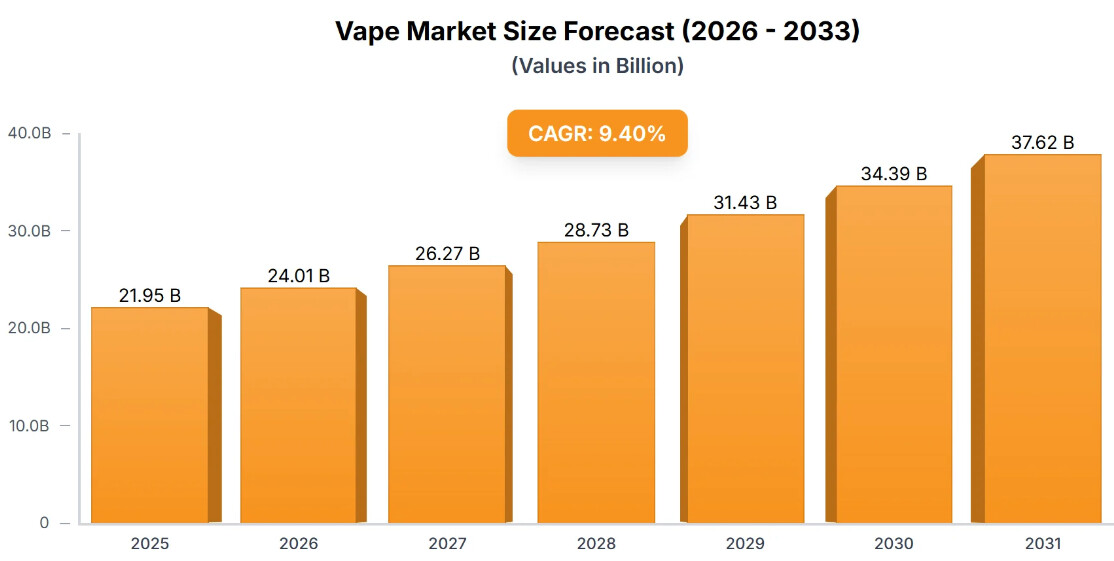
Growth has clearly cooled. Annual expansion now sits at 3–6%, with longer-term CAGR expected around 2–4%. Spain remains one of Europe’s faster-growing vape markets (some forecasts point to 5.76% CAGR through 2031), but the easy gains are behind us.
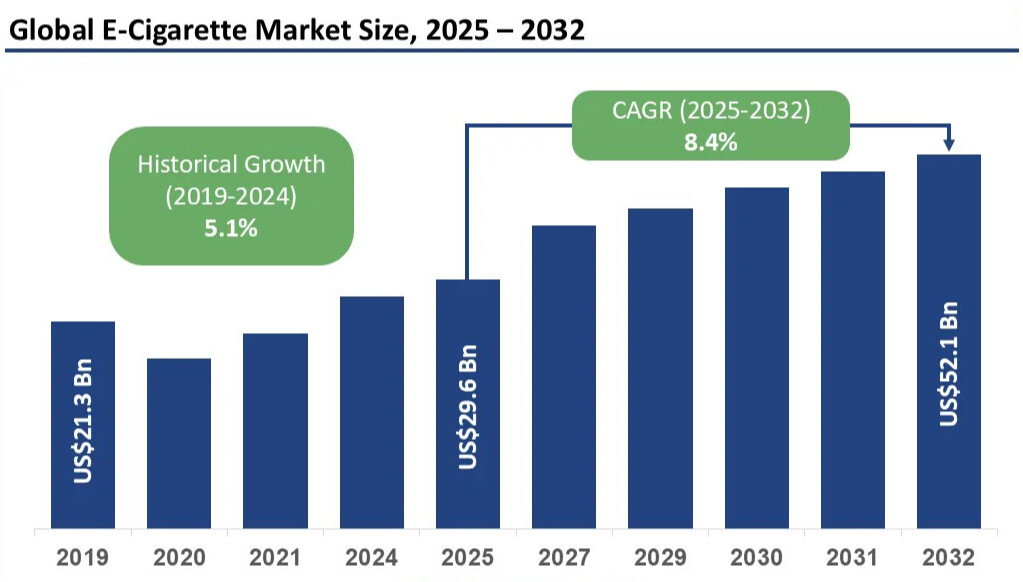
What’s driving growth
- Rising health awareness and harm-reduction demand.
- Higher tobacco taxes pushing smokers toward vaping.
- Strong distribution networks built by players like Philip Morris.
What’s holding it back
- Tightening TPD rules (a new revision is on the horizon).
- Higher taxes—currently €0.12 per ml on e-liquid.
The market has moved from rapid expansion into a more mature, steady-state phase.
4. Product Structure Breakdown
Disposable vapes still rule the roost, accounting for 50–60% of the market. They’re simple, convenient, and dominate shelf space, but they face the greatest regulatory pressure looking ahead.
Pod systems (closed, replaceable cartridges) make up 30–40% and are quietly gaining ground as the compliant alternative many brands are shifting toward. Open-system devices (mods and refillable tanks) remain a niche play, under 10% of volume, appealing mainly to experienced users.
Price landscape
Most products sell in the $5–10 range. Competition is fiercest in the mid-to-low price segment, where value-driven buyers shop.
Takeaway: The market still runs on disposables, but anyone planning beyond the next 12–24 months should start shifting resources toward compliant pod products.
5. Competitive Landscape and Brand Ecosystem
The Spanish vape market is dominated by Chinese-origin brands, yet traditional tobacco giants are actively carving out space.
Tier 1 (Leaders): Elf Bar, Lost Mary, Vuse, VEEV
Tier 2 (Strong Contenders): Geek Bar, Vozol, SKE, VAPEPIE
Tier 3 (Rest of Market): Smaller brands, white-label products, regional names, and newcomers
Right now, distribution strength matters more than pure brand equity. Whoever controls the flow of goods to retailers wins shelf space. Market concentration is increasing, but no single player has achieved total dominance. The shift from “weak brand” competition toward genuine brand-building is underway.
6. Distribution Channels and Sales Systems
Spain remains an overwhelmingly offline market.
- Vape shops: 55–65% of sales (the undisputed heart of the business)
- Traditional tobacco shops: 15–20%
- Supermarkets/hypermarkets: 5–10%
- Nightlife/gray channels: 10–20%
- Online: under 10%
Vape shops are where the real action happens—roughly 1,500–2,500 specialty stores nationwide, each averaging $3,000–10,000 in monthly vape sales. They handle not just transactions but also customer education and conversion. Controlling these outlets is far more important than simply opening more doors.
Traditional tobacco shops (around 13,000 licensed outlets) provide stable reach but play a supporting role due to product and training limitations. The overall trend is toward greater channel concentration and standardization.
7. Consumer Behavior and Demand Patterns
The typical user is 18–35 years old (65% of the base), male (60–70%), and spends $20–50 per month—roughly $200–600 per year.
Main motivations
- Smoking replacement: 40–50%
- Social/relaxation use: 30–40%
- Novelty or trial: 10–20%
Key usage occasions
- Everyday smoking substitute: 40–50%
- Nightlife and social settings: 30–40% (a distinctly Spanish flavor compared with other European markets)
Flavor preferences lean heavily toward fruit (over 50%) and cooling/ice sensations (20–30%). Most users prefer high-nicotine options (60%+ choose 20 mg/ml).
In short, Spanish vapers treat the product as both a practical smoking alternative and a social consumable. Strong flavors and higher nicotine remain the mainstream sweet spot.
8. Key Consumption Cities Breakdown
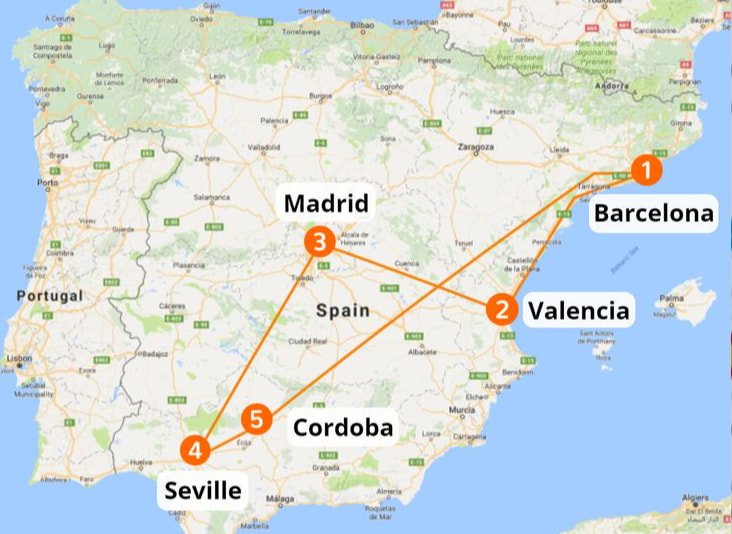
Tier 1 (Must-Win Markets) – Madrid + Barcelona (40–50% of national volume)
Dense vape-shop networks, high population, and intense competition. This is where brands build credibility.
Tier 2 (Best Value for Expansion) – Valencia + Seville (20–30%)
Faster growth and less saturation. Excellent risk-reward ratio for scaling.
Tier 3 (Opportunistic Coverage) – Málaga, Bilbao, and other regional cities (20–30%)
More fragmented, often seasonal (tourism-driven). Best handled through local agents rather than heavy direct investment.
9. Nicotine Pouches and Heat-Not-Burn (HNB) Market Overview
Nicotine Pouches (Oral Nicotine)
This category is on a tear. Market value grew from $151 million in 2024 to an expected $172 million in 2025, with forecasts reaching $775 million by 2034 (CAGR 18.2%). Volume is projected to jump from 5 million cans in 2025 to 8 million in 2026. Leading players include ZYN (PMI), Velo (BAT), and Nordic Spirit.
Growth is still in the early, high-velocity phase (60%+ year-on-year in recent periods). Policy risk is real—proposed nicotine caps and new taxes could choke the category—but the upside remains substantial. Many see pouches as a natural hedge or complement to vaping.

Heat-Not-Burn (HNB)
A much more mature, IQOS-dominated segment valued at $572 million in 2024 and projected to reach $2.645 billion by 2033 (CAGR 18.68%). Spain accounts for about 1.68% of the global HNB market. Channels are well established (IQOS boutiques plus tobacco shops), but the barrier to entry for newcomers is extremely high. Most new players should watch this space rather than compete directly.
10. 2026–2028 Trends and Entry Strategies
Over the next three years the market will be shaped by five big forces:
- Continued modest growth (2–4% annually).
- Policy as the primary wildcard.
- Gradual shift away from disposables toward more compliant formats.
- Further channel consolidation.
- Steady but non-explosive evolution in consumer preferences.
Recommended Entry Path
Phase 1 (Months 0–6): Focus on Madrid and Barcelona, secure agent partnerships, and test product fit.
Phase 2 (Months 6–12): Expand into Valencia and Seville, scale core SKUs, and stabilize distribution.
Phase 3 (Year 2 onward): National agent coverage, refine the product mix, and explore nicotine-pouch alternatives.
Final strategic advice: Avoid putting all eggs in one basket. Don’t rely solely on disposables, a single channel, or heavy capital investment. The Spanish vape market is best treated as a genuine but time-limited opportunity window.
11. Top Channel Partners and B2B Distribution Analysis
Tier 1 – National Logistics Giants
Logista Integral stands out as the dominant player, operating the largest tobacco and consumer-goods distribution network in Spain (and parts of Europe). It reaches over 200,000 points of sale with food-grade logistics standards.
Tier 2 – Vape Specialists
- VapVip: Carries 86 brands, official authorizations, and strong coverage across Spain and Europe.
- Mas que Vapor: Operates seven stores in Madrid with retail and customization services.
- 1Ejuice: Global e-liquid distributor offering low minimum orders and fast delivery.
Tier 3 – Regional and Emerging Players
Eciglogistica (Valencia), Delta Baco (tobacco-shop focused), Vaperalia, VaporSmoke, and newer online platforms such as NicoBoost (nicotine-pouch specialist) and Icyshop.
Practical Advice for Partners
New brands should prioritize tying up with specialists like VapVip for quick validation, layer in online platforms for broader reach, and keep relationships with 2–3 strong distributors to spread risk. Compliance certification, fair channel pricing, reliable stock replenishment, and marketing support are the non-negotiables for successful partnerships.
In Spain, the real competitive edge is still distribution muscle. Choosing the right partners often matters more than having the flashiest product.