The U.S. Food and Drug Administration published a long-awaited guidance document on May 8, 2026, giving the clearest picture yet of how it plans to prioritize enforcement against certain e-cigarettes and nicotine pouches that remain on the market without premarket authorization. The document, released by the FDA’s Center for Tobacco Products, is titled Enforcement Priorities for Certain New Tobacco Products Marketed Without Premarket Authorization and focuses squarely on electronic nicotine delivery systems (ENDS) and nicotine pouch products.
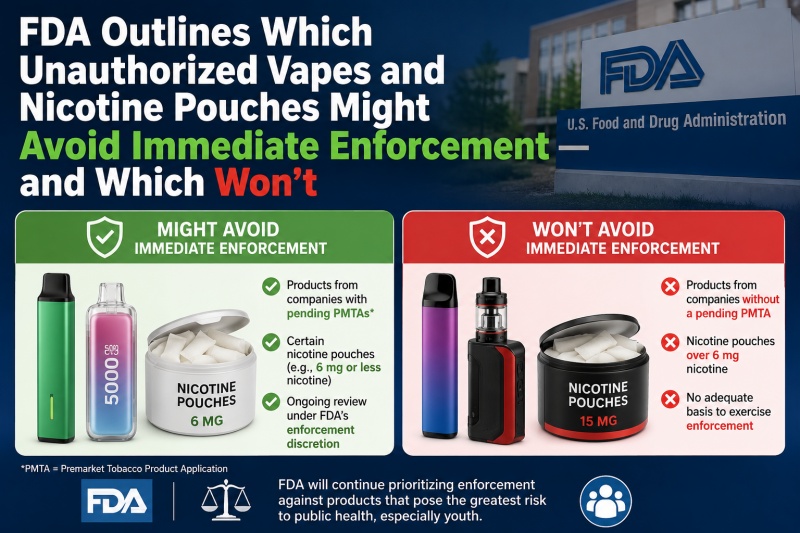
The agency made one thing clear from the start: it isn’t easing up on the illegal tobacco market. FDA officials reiterated that unauthorized products undermine the regulatory framework and expose consumers to items that haven’t undergone the required scientific review. The agency said it will continue working with the Department of Justice, Customs and Border Protection, and other federal partners to intercept and destroy illegal shipments at the border, aiming to stop them before they reach store shelves or end up in the hands of minors.
When the FDA Won’t Make You a Priority
At the center of the new guidance is a set of circumstances under which the FDA does not intend to prioritize enforcement action against certain unauthorized ENDS and nicotine pouch products. Essentially, the policy carves out some breathing room for products that have a pending premarket tobacco product application (PMTA) — provided that application has been accepted and filed by the agency. The same applies if a manufacturer has a pending supplemental PMTA that has been accepted for review.
For non-tobacco-flavored ENDS products, the guidance goes a step further. The FDA indicated that these products may also fall under the enforcement discretion if the agency determines the application includes the data necessary to assess whether the product is “appropriate for the protection of public health.” That’s a notable detail, as flavored vaping products have been among the most heavily scrutinized categories in the PMTA process.
The Fine Print: Youth Appeal and Safety Red Flags Still Trigger Action
Even if a product fits the above criteria, the FDA spelled out specific elements that could still push it to the top of the enforcement list. Anything the agency views as particularly attractive to young people remains a hard line. The guidance calls out designs that use cartoon-like fictional characters, conceal the product’s identity as an e-cigarette, or mimic items like children’s toys, smartphones, or gaming devices. Those kinds of features can invite swift action, no matter the application status.
Beyond youth appeal, the policy also highlights public health and safety risks that go beyond what’s typical for e-cigarettes or nicotine pouches. The agency pointed to examples such as products with exceptionally high nicotine concentrations, those linked to a greater number of serious or unexpected adverse events compared to authorized alternatives, products lacking child-resistant packaging as required by the Child Nicotine Poisoning Prevention Act of 2015, and devices that present a potential fire hazard. Any of these issues could make a product an immediate enforcement target.
A Public List Is Coming
To bring more transparency for retailers and consumers, the FDA said it will create and maintain a publicly accessible list showing manufacturers and products for which, under this policy, the agency does not plan to prioritize enforcement. Manufacturers who want their products reflected on that list can reach out to their assigned regulatory health project manager or contact the Center for Tobacco Products through a designated email address. The FDA noted that manufacturers emailing that address will receive an automatic reply and can expect more details about the public webpage in follow-up communication.
Not a Green Light for Authorization
Perhaps the most important caveat tucked into the announcement is that a product’s eligibility under this enforcement policy says nothing about its chances of ultimately getting marketing authorization. The FDA stressed that this guidance is purely about enforcement priorities — where the agency will focus its limited resources — and does not signal that a product is more likely to pass the scientific review required for a marketing order. For now, the guidance offers temporary enforcement discretion for some, but the bar for full authorization hasn’t moved.